Misssix
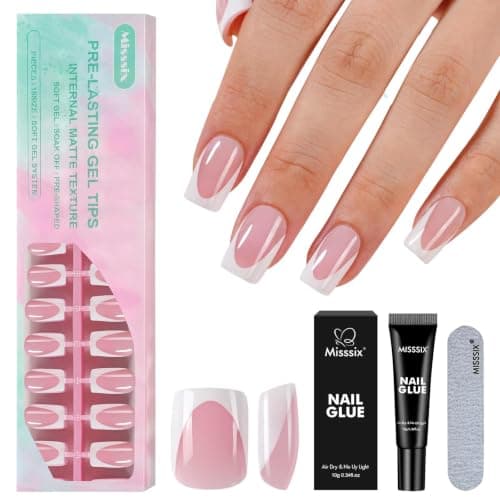
Misssix Deep French Short Square Tips, 150 pcs
$9.99
Deep French, short lengthSold as deep French soft-gel tips: 150 short square tips in 15 sizes, with 10g nail glue and a mini file in the kit, per the listing.
Shop on AmazonFrench tip nails category
deep french tip nails
Deep french tip nails explained: the steep, high smile line, why it slims the nail, which shapes suit it, the short-nail limit, painting steps and press-ons.
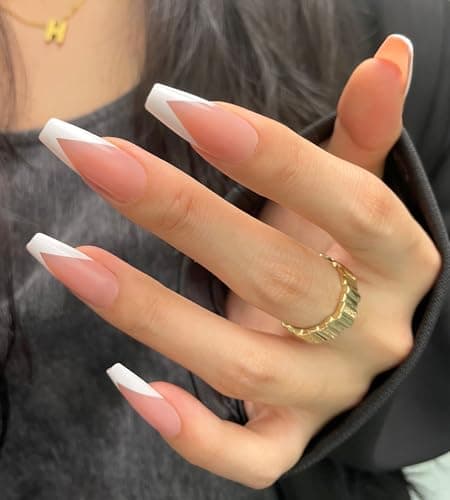
Deep french tip nails use a steep, high-arched smile line: the white dips low in the centre of the nail and sweeps up the sides, with its two side points reaching well back towards the cuticle. Compared with the shallow curve of a classic French, the deep version makes the nail look longer and slimmer. It suits coffin, almond and longer square nails, and it needs some free edge to work.
That is the whole look in one paragraph. The rest of this page is about getting it right, because a deep curve that is slightly off reads as a chunky, uneven tip rather than a deliberate one.
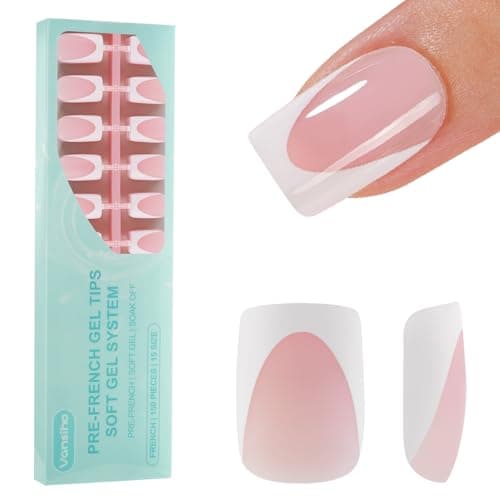
Sold as deep French soft-gel tips: 150 short square tips in 15 sizes, with 10g nail glue and a mini file in the kit, per the listing.
Shop on AmazonThe long square version of Misssix's deep French soft-gel tips: 150 pieces in 15 sizes with an inner frosted back for glue grip, per the listing.
Shop on Amazon150 short square soft-gel tips in 15 sizes, 10 per size, sold as deep French; the listing says no primer is needed.
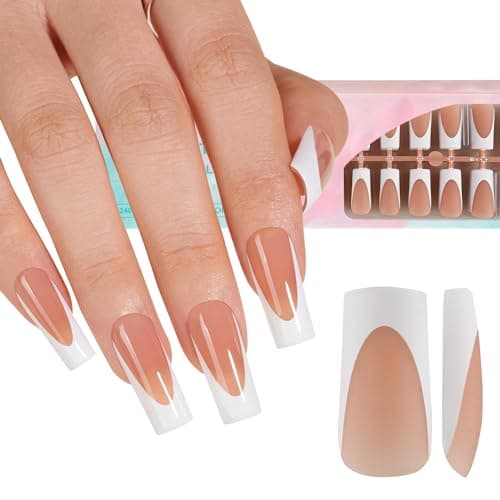
Shop on AmazonLong coffin acrylic press-ons with a V-shaped French tip, 30 nails in 15 sizes, with adhesive tabs, mini file and cuticle stick, per the listing.
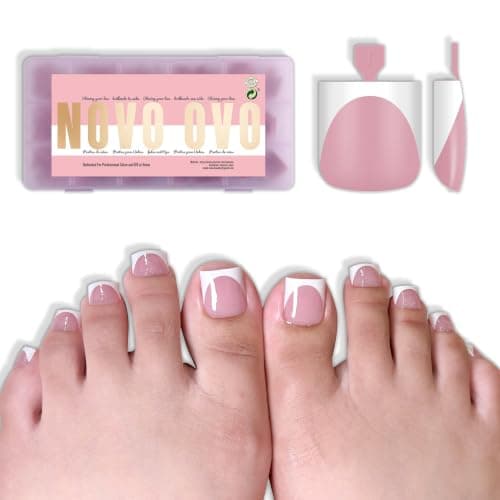
Shop on AmazonPre-designed soft-gel toe tips with a deep curve white French on a berry pink base, sharp square, 240 pieces in 15 sizes, per the listing.
Shop on AmazonProduct prices and availability are accurate as of November 3, 2026 and are subject to change. Any price and availability information displayed on Amazon at the time of purchase will apply. As an Amazon Associate we earn from qualifying purchases. Star ratings reflect Amazon customer reviews at the time of our last check.
Every French manicure is defined by its smile line, the boundary between the white tip and the nude or pink base. The depth of that line is a scale, and the deep French sits in the middle of it.
| Classic French | Deep French | V (pointed) French | |
|---|---|---|---|
| Shape of the line | Gentle, shallow curve | Pronounced U, steep sides | Two straight lines meeting at a point |
| How far the side points climb | Barely past the free-edge corners | Roughly a third to halfway back along the side walls | Similar to deep, but the centre also rises into a point |
| What the eye reads | A neat band of white | Long diagonals, a narrow nude centre | A sharp arrow towards the tip |
| Best shapes | Any shape | Coffin, almond, medium-to-long square | Coffin, almond, stiletto |
| Minimum length | Short, even at the fingertip | Clearly past the fingertip | Medium or longer |
| Hardest part | Keeping the band even | Matching the two side points | Getting the point centred |
At the opposite end of the scale from the deep French is the micro French, a hairline of white kept right at the edge; the micro French tip nails page covers that end. Push the deep idea further and it becomes the V French, where the curve straightens into a point.
This is the single most common mix-up, at home and in salons.
When people say a deep French "didn't work" on them, they often got a thick one. If you want the long-and-slim effect, the instruction is "deep curve, slim centre", not "more white".
The effect is geometry, not magic. A shallow curve leaves a wide, rounded nude area that mirrors the nail bed, so the nail looks about as wide as it really is. A deep curve cuts into that nude area from both sides, leaving a taller, narrower shape in the middle. The eye judges the nail partly by that inner shape, so the whole nail reads as narrower.
The two side points add to it. Each one is a diagonal line running from the free edge back along the side wall, and diagonals read as length. The deeper the points go, the stronger the effect, up to the point where the white starts to dominate the nail and the illusion flips into "mostly white nail".
A useful ceiling: keep the nude centre at least as tall as the white below it. If the white covers more than half the visible nail, it has stopped being a French and become a tip with a nude stripe.
The steep curve needs side wall to climb, and some shapes give it more than others.
Searchers looking for the deep French almost always attach a shape to it, and the shape is usually coffin.
| Query | Google impressions | Average position |
|---|---|---|
| deep french tip coffin nails | 7 | 6.7 |
| deep french coffin nails | 7 | 6.9 |
| deep french nails coffin | 4 | 10.0 |
| deep french nails square | 2 | 22.0 |
Source: Google Search Console export for lovefrenchtipnails.com, 27 July – 26 October 2026, read 29 October 2026. Impressions are per query, used only to compare phrasings; not a traffic total.
Three of the four phrasings name coffin, and together they account for 18 of the 20 impressions. A separate question also turned up in the same data: whether a deep smile line can be done on short nails with extensions. That question gets its own section below, because the honest answer has a condition attached.
Yes, but only with free edge, and if your natural nail does not have it, extensions are the way to get it.
The steep curve needs somewhere to go. On a nail filed level with the fingertip, the white has a couple of millimetres to work in. Paint a deep curve into that space and one of two things happens: the curve flattens out because there is no room for the points to climb, or the points climb into the nail bed area and the white swallows most of the nail.
What works on short nails:
What does not work on short nails:
If your nails are short and you want a French that suits them as they are, the short French tip nails page is a better starting point.
The centre of the curve is the easy part. The side points are where the look is won or lost, so build the line from the sides inwards.
A thin, long-bristled liner gives far more control on the side strokes than the brush in a polish bottle, which is too wide and too short to pull a sharp point.
Most salons know the look, but the words vary, so give them something concrete.
Do say:
Don't rely on:
For more on wording and what to bring, see how to ask for French tips at the salon.
If your nails cannot grow the length, press-ons are the most reliable way to get a deep French, because the curve is already painted on. A few things to check in the listing:
The products below are picked from what each listing states about shape, depth and contents; the site does not wear-test products. For more press-on options in other styles, see press-on French tip nails.
A deep French puts white right where the nail bends most, at the side corners, so a strong, flexible nail underneath matters. The American Academy of Dermatology's healthy nail tips are the plain version: keep nails clean and dry, moisturise the nails and cuticles, and do not bite, pick or tear at them. Between gel or press-on sets, letting the nail rest bare for a while makes the next deep line sit on a smoother surface.
What French tip shoppers are buying this week, across every category.
What is a deep French tip?
A French manicure whose smile line is cut steeply, so the white climbs high up the side walls of the nail and dips low in the centre. A classic French has a gentle, shallow curve; a deep French has a pronounced U, with the side points of the white reaching well back towards the cuticle.
Is a deep French the same as a thick French?
No. Thick describes how much white sits in the centre of the nail. Deep describes how steep the curve is, measured by how far the side points climb. A deep French can be fairly slim in the middle, and a thick French can have an almost flat curve. Salons mix the two words up, so say which one you mean.
Can you do a deep smile line French on short nails?
Only if there is free edge to work with. A deep line needs length beyond the fingertip for the side points to climb into; on a nail kept level with the fingertip the curve flattens out or swallows the nail. Extensions, soft-gel tips or press-ons solve this by adding the free edge your natural nail does not have.
Which nail shape is best for a deep French?
Coffin and almond carry it best, because their side walls taper and the steep curve follows that taper. Square works when the nail is medium or longer. Round and very short squoval nails struggle, because there is not enough side wall for the points to climb.
Does a deep French make nails look longer?
It usually does. The side points draw two long diagonal lines up the nail, and the eye reads those as length. The pink or nude area in the centre also becomes a narrower, taller shape, which looks slimmer than the wide oval left by a shallow curve.
How do I ask for a deep French at the salon?
Ask for a deep or high smile line, with the side points of the white reaching about halfway back along the side walls, and say you want the centre of the white kept slim. Showing a photo taken straight on, not at an angle, helps more than any wording.
Is a deep French harder to paint at home?
A little. The hard part is not the centre but the two side points, which have to be sharp and match each other. A thin liner brush, painting each side from the point inwards, and cleaning up with a flat brush dipped in remover make it manageable.
Is a V French the same as a deep French?
They are close relatives. A V French takes the deep idea to its end, with straight lines meeting in a point instead of a curve. If a deep curve feels too soft for a sharp coffin or stiletto, the V is the next step.
Almond French Tip Nails
almond french tip nails
Black French Tip Nails
black french tip nails
Blue French Tip Nails
blue french tip nails
Blue Square French Tip Nails
blue square french tip nails
Brown French Tip Nails
brown french tip nails
Burgundy French Tip Nails
burgundy french tip nails
Chrome Coffin French Tip Nails
chrome coffin french tip nails
Chrome French Tip Nails
chrome french tip nails