French Tip Nail Guides vs Stamps: What Actually Works

Something unusual shows up when you sort French tip guides by customer rating: the category is bad. Not one product — the category. Ratings cluster between 3.2 and 4.0 stars, well below nail brushes, polish, or press-ons, and the negative reviews say the same two things over and over.
This is worth knowing before you spend anything, because guides are the tool most often recommended to beginners.
Guides and stamps worth buying
Only products rating 4.0 stars or above made this list — which knocked out most of the sticker category. The reason is worth reading before you buy.
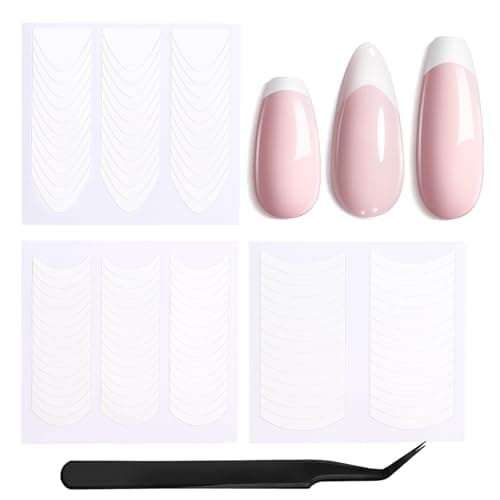
Beetles French Manicure Stickers, 30 sheets
The widest curve range in a single pack, which matters more than sheet count — a guide cut for a square nail will not sit flat on an almond one. Beetles' adhesive is on the lighter side, so these peel off without dragging half-cured polish with them.
Light adhesive is a trade-off: on very oily nail plates they can lift mid-stroke. Wipe with alcohol first.
Check price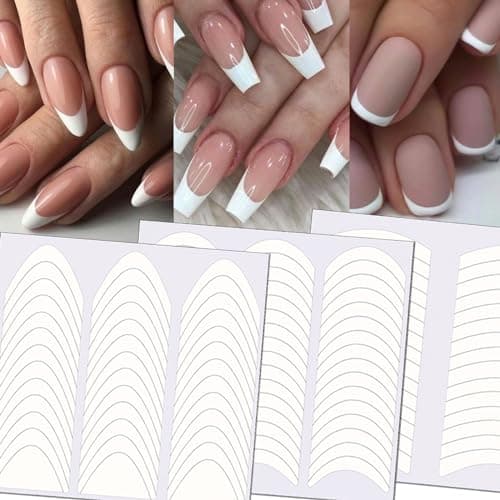
TailaiMei French Manicure Guides, 1,368 pieces
1,368 pieces works out to roughly half a cent per guide, which changes how you practise — you stop rationing them and start redoing the line until it is right.
Curve variety is narrower than the Beetles pack. Fine if your nails are a standard width, limiting if they are not.
Check price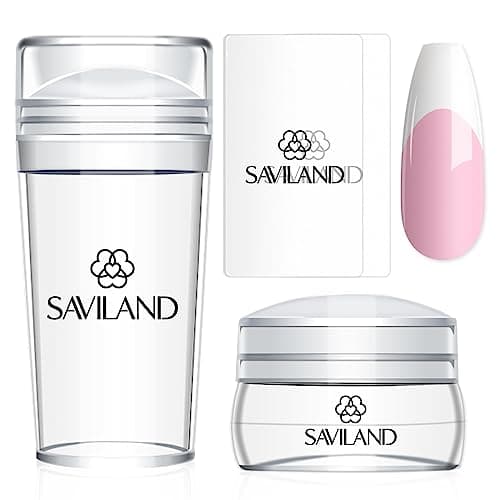
SAVILAND French Tip Silicone Stamper, 4 pcs
Worth knowing before you buy stickers at all: adhesive guides in this category rate poorly across the board, and stamping is the method most people move to after fighting with them. You press the curve on instead of masking it off.
Uniform line depth on every finger — less per-nail control than a guide or brush.
Check price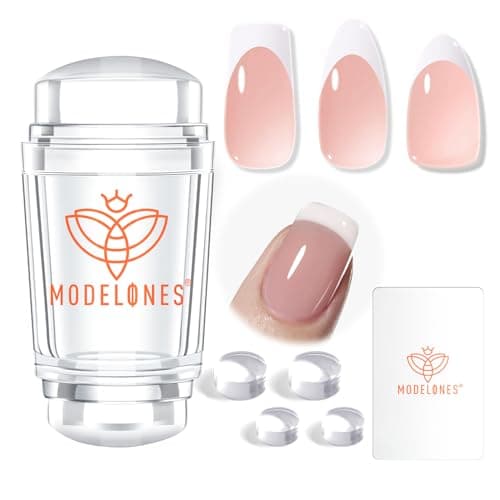
modelones French Tip Stamper, 6 pcs
Six heads covers more nail widths and curve depths than the four-piece sets, which is what makes stamping work across a whole hand rather than just the middle fingers.
More pieces to clean between colours.
Check priceProduct prices and availability are accurate as of July 29, 2026 and are subject to change. Any price and availability information displayed on Amazon at the time of purchase will apply. As an Amazon Associate we earn from qualifying purchases. Star ratings reflect Amazon customer reviews at the time of our last check.
Why the category rates so poorly
The complaints are consistent.
The adhesive is wrong in one direction or the other. Too weak and the sticker lifts as your brush drags across it, which produces a worse line than freehand. Too strong and it takes the base colour with it on removal. Manufacturers cannot win, because the correct adhesion depends on a base coat cure they cannot control.
The curve does not fit. Most packs advertise sheet count rather than curve variety. A guide cut for a 12mm square nail will not sit flat on a 9mm almond one, and a sticker that does not sit flat lets polish bleed underneath. This is why "1,368 pieces" is a less useful number than it looks.
Both problems are real, and neither is solved by spending more.
The technique that makes guides work anyway
If you want to use them, three details do most of the work.
Cure or dry the base completely — longer than you think. This single factor causes most of the lift-off complaints.
Apply colour from the sticker toward the nail tip, never toward the sticker. Brushing into the edge pushes polish underneath it; brushing away from it does not.
Peel while wet, immediately. Every second you wait lets the polish film set across the sticker edge, and peeling then tears the line ragged.
Get those three right and a mediocre pack performs acceptably. Get them wrong and the best pack in the world still fails.
Stamps: the option most people move to
Silicone French stamps rate substantially better than adhesive guides, and the reason is structural rather than about quality. A stamp does not need to adhere to anything. You load the curved silicone head with polish, press it onto the nail, and lift. There is no adhesion to fail and no removal step to go wrong.
What you give up is per-nail control. Every finger gets the same curve depth, which on a hand where the thumb is much wider than the pinky can look slightly uniform. For a classic French, most people consider that fine or even desirable.
If you have already fought with stickers and lost, this is the thing to try next.
The free alternative nobody mentions
You do not need a consumable at all. Paint the tip freehand and roughly — deliberately overshooting the line — then take a flat brush dipped in acetone or gel cleanser and wipe the curve back out. You are carving the smile line by subtraction instead of drawing it.
This is more forgiving than any guide, costs nothing beyond a brush you likely want anyway, and gives complete control over depth on every individual nail. It is genuinely how a lot of people who are good at French tips actually do it.
Cost per manicure, honestly
Guides look cheap and are, but the per-use maths is worth doing because it changes which pack makes sense.
Each manicure consumes ten guides, and they are single-use once polish touches them. A 1,368-piece pack is therefore about 136 manicures; a 576-piece pack is about 57. At typical prices that lands between four and six cents per manicure, which is genuinely negligible.
A silicone stamper, by contrast, is a one-off purchase that never runs out. At around eight dollars it breaks even against stickers within a couple of hundred manicures — but that was never really the argument. The argument for a stamp is reliability, not cost.
The clean-up brush method costs nothing per use at all, since acetone and a brush you already own are the only inputs. If cost is genuinely the deciding factor, that is the winner by a wide margin.
What to do when a guide fails mid-manicure
It will happen. The sticker lifts, polish bleeds underneath, and you now have a smudged line on one nail while nine others are fine.
Do not remove the whole nail and start over. Take a flat brush, dip it in acetone or gel cleanser, and wipe the line back to where it should be. You are using the clean-up technique as a repair rather than as your primary method, and it works just as well for that.
If the bleed is severe enough that the base colour is contaminated, wipe the tip area back to the base and redo just the tip. This is much faster than a full strip, and because the base is already cured underneath, acetone on the surface does not disturb it.
Keep a flat brush and a small pot of cleanser next to you whenever you use guides. Assume you will need it on at least one nail, and the whole process stops being stressful.
What we would buy
Of the sticker packs, only two clear 4.0 stars: Beetles' 30-sheet pack, which has the widest curve range, and TailaiMei's 1,368-piece pack for sheer volume at roughly half a cent per guide.
But the honest recommendation is to skip straight to a stamp or a clean-up brush. The SAVILAND four-piece stamper rates 4.0 across ten thousand ratings; the modelones six-piece gives more curve depths. Either is a more reliable route to a clean line than the sticker category as a whole.
For the brush-based approach, see the best French tip nail brush. For polish opaque enough that one pass covers — which matters enormously with guides, since a second coat means re-applying the sticker — see white gel polish for French tips.
The technique walkthrough lives in how to do French tips at home, and if guides keep failing on your nail shape, French tips on short nails explains why short beds and deep curves fight each other. For the finished looks, browse simple French tips and white French tips.
Common questions
- Do french tip nail guides actually work?
- They work when the curve matches your nail width and the base coat is fully cured. They fail when either is untrue, which is often — the average rating across this whole product category sits below 4 stars, considerably lower than nail brushes or polish. The failure mode is the sticker lifting mid-stroke or pulling colour off when removed.
- When should you peel off the guide?
- While the polish is still wet, immediately after the stroke. Waiting for it to dry means the polish film has formed across the sticker edge, so peeling tears that film and leaves a ragged line. With gel, remove before curing — never cure with the sticker on.
- Why do my french tip stickers pull the polish off?
- The base underneath was not fully dry or cured. Adhesive guides bond to the topmost layer, and if that layer is still soft the sticker takes it with it. Cure gel base for the full lamp time, and give regular polish considerably longer than it feels like it needs.
- Are silicone stamps better than sticker guides?
- For consistency, yes — and buyer ratings back this up. A stamp presses the same curve every time and does not depend on adhesion. The trade-off is that every nail gets an identical line depth, so you lose per-finger control. For most people wanting a uniform classic French, that is a feature.
- What can I use instead of french tip guides?
- Thin striping tape, the curved edge of a hole-reinforcement sticker, or a clean-up brush with acetone. The clean-up brush method — paint the tip roughly, carve the curve back — needs no consumables at all and is what most people end up preferring.
- How many guides do I need per manicure?
- Ten, one per nail, and they are single-use once polish touches them. A 1,000-piece pack is roughly 100 manicures, which is why buying in bulk is sensible if this is your method.
Keep reading
- Chrome Powder for French Tips: Getting the Mirror Finish Right
- Best French Manicure Kit: What Belongs in One (and What Doesn't)
- The Best French Tip Nail Brush for a Clean Smile Line
- Best Press On French Tip Nails: 6 Sets Worth Your Money
- Best White Gel Polish for French Tips: Opacity Is Everything
- Almond French Tip Nails
- Black French Tip Nails
- Blue French Tip Nails
- Brown French Tip Nails
- Chrome Coffin French Tip Nails
- Chrome French Tip Nails
Back to French tip nails or browse all our picks.